The Truth About the Razer Joro: Pros, Cons, and Verdict
Introduction
The Razer Joro is the latest entry in Razer's laptop lineup that aims to balance portable form factor with the performance demands of modern users. Razer, a brand long associated with gaming and premium design, positions the Joro as a contender for buyers who want a machine that can do a bit of everything: run games at playable frame rates, handle creative workloads, and remain light enough to carry through a workday. This article examines what the Joro delivers in real-world use, where it falls short, and who should seriously consider it.
The analysis that follows focuses on practical impressions: performance in common workflows, battery consequences of performance modes, ergonomics for extended use, connectivity for peripheral-heavy setups, and long-term considerations like upgradeability and support. Rather than listing every technical spec, the goal is to help potential buyers make an informed decision based on how people actually use laptops day to day.
Design and Build
The Joro leans into Razer’s established design language: clean lines, matte finishes, and a subdued aesthetic that makes it suitable for both gaming and professional settings. The chassis uses lightweight materials intended to balance sturdiness and portability. The hinge typically feels firm, and the overall footprint is tuned to be smaller than many 15-inch gaming rigs while still accommodating a full-size keyboard.
Buyers who care about travel will appreciate the thin profile and the way the laptop fits in a carry case. For those who prioritize durability, pay attention to the warranty and consider a protective sleeve — premium finishes are attractive, but they can show wear over time. Razer’s brand typically bundles a predictable software suite for hardware control; some users find it useful, while others prefer a cleaner OS experience.
Display and Media Experience
One of the most consequential parts of a laptop for both gamers and creatives is the display. The Joro is offered with display options that skew toward high-refresh-rate panels for gaming and higher-resolution or higher-color-accuracy panels for creators. In practice this means buyers can expect choices such as a fast 1080p 144–240Hz panel for competitive play or a sharper 1440p/IPS panel with wider color gamuts geared toward content work.
For streaming, media consumption, and video editing, color coverage and uniformity matter more than peak refresh rate. Photographers and video editors will want to prioritize Joro configurations with sRGB/Adobe RGB coverage and consider external calibration. Gamers who play fast-paced titles will favor the high-refresh options for smoother motion and lower perceived input lag.
Performance: Real-World Use
Performance on the Joro depends heavily on the chosen configuration. Typical configurations pair modern mobile processors (both AMD and Intel are commonly used in this segment) with discrete NVIDIA GeForce mobile GPUs. In everyday productivity tasks—web browsing, document editing, video calls—the Joro performs very well, with snappy responsiveness and near-instant app launches when equipped with an NVMe SSD.
For gaming, the Joro can comfortably handle 1080p gaming across a wide range of titles. Competitive esports titles will hit high frame rates on high-refresh panels, while modern AAA games will require a mix of medium-to-high settings for steady performance. For creative workloads such as video rendering, 3D modeling, or large photo edits, higher-tier CPU/GPU configurations speed up timelines significantly and make the Joro a viable portable workstation for content creators who need mobility.
Thermal constraints are intrinsic to thin-and-light designs. Under sustained heavy loads—long gaming sessions or extended rendering—the system will raise fan speeds and, depending on the thermal solution, may throttle to manage temperatures. That behavior is typical across similarly sized laptops; prospective buyers should weigh raw performance against thermals and fan noise based on their typical workload.
Battery Life and Portability
Battery life depends on display choice, power profile, and whether the discrete GPU is active. In real-world mixed productivity—email, browsing, streaming—expect respectable runtimes that allow for a work session away from a power outlet, but not all-day autonomy if the display is a high-refresh or high-resolution panel. A practical expectation is several hours of active work; with conservative settings and power-saving options, users can stretch this further.
Gamers should plan to game while plugged in for sustained performance; battery-powered gaming on any discrete-GPU laptop tends to be a trade-off between framerate and battery life. Content creators traveling between shoots will need to be mindful of power adapters and possibly consider carrying a high-capacity external battery pack if on-location editing is required.
Shop the latest Laptops & Computers picks on Amazon.
View Offers →Thermals, Noise, and Everyday Comfort
Cooling in the Joro aims to strike a compromise—maintain high performance for short bursts and manage sustained loads without excessive surface temperatures. In practice, short gaming sessions or media exports are handled well with moderate fan noise. For prolonged heavy workloads, fans ramp up noticeably and may be audible in quiet environments.
Thermal throttling is a consideration for users who need sustained peak performance (for example, live streaming while gaming or rendering long videos). For those use cases, a larger chassis or a desktop-class machine will outperform any thin-and-light laptop. Buyers who prioritize quiet operation during office work may prefer to adjust performance profiles or choose a configuration that leans toward efficiency rather than maxed-out GPU power.
Keyboard, Trackpad, and Input
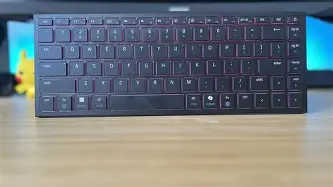
The Joro’s keyboard emphasizes comfortable travel and tactile feedback, which benefits both typing-heavy workflows and longer gaming sessions. Keycaps are typically well-spaced, and backlighting options (single-zone or per-key RGB, depending on SKU) let users customize visibility in low-light conditions. The trackpad is roomy and responsive; those who prefer dedicated gaming mice will find plenty of USB and wireless options.
For hybrid workers, webcam quality and microphone performance are important. The Joro usually includes a webcam sufficient for video calls, but users who rely heavily on video conferencing or content capture might opt for an external webcam or microphone for better low-light or noise-cancelling performance.
Connectivity and Upgradeability
Port selection on the Joro is designed to cover common needs: multiple USB-A, USB-C/Thunderbolt (in many configurations), HDMI or DisplayPort output, and a headphone jack. The presence of Thunderbolt or USB-C with power delivery greatly increases flexibility for docking stations and external displays. Buyers who use several external peripherals—multiple monitors, external storage, audio interfaces—should verify the exact port configuration for the SKU they plan to buy.
Upgradeability varies by model and market. Some configurations allow for user upgrades to RAM and storage, while others solder components to the motherboard to save space. Buyers interested in extended lifespan should look for models that permit at least SSD upgrades and additional RAM slots, or plan on purchasing the highest practical configuration upfront.
Pricing and Value
Pricing for the Joro spans a range depending on CPU, GPU, display, and storage options. Entry configurations offer a reasonable balance for buyers who want a compact machine for mixed-use, while top-tier configurations push into premium prices typically reserved for high-end gaming or creator laptops. Value is subjective: for someone who needs a portable daily driver with occasional gaming, a mid-range Joro can represent good value. For those who need sustained workstation-class performance, desktop alternatives or larger, heavier laptops may offer better price-to-performance ratios.
Pros & Cons
Pros
- Versatile design: Suitable for both gaming aesthetics and professional environments.
- Configurable performance: Multiple CPU/GPU and display options let buyers match the machine to their needs.
- Portable footprint: Thin-and-light chassis makes it easy to carry for students, professionals, and frequent travelers.
- High-refresh displays available: Good choice for competitive gamers and those who value smooth motion.
- Quality keyboard and trackpad: Comfortable for extended typing and general productivity.
Cons
- Thermals constrain sustained performance: Thin designs can throttle under prolonged heavy loads.
- Fan noise: Under load, fans can become noticeable which may be distracting in quiet spaces.
- Battery trade-offs: High-refresh and high-resolution displays reduce battery life compared with more efficient panels.
- Potential limited upgradeability: Some SKUs may solder RAM or restrict user upgrades.
- Premium pricing at top configurations: High-end models approach prices of established desktop-replacement machines.
How the Razer Joro Compares (Quick Table)
| Model | Target User | Typical CPU | Typical GPU | Display Options | Battery (Real-world) | Weight | Approx. Price Range |
|---|---|---|---|---|---|---|---|
| Razer Joro | Portable gamers & creative professionals seeking balance | Modern mobile Intel/AMD chips (energy-efficient and high-performance variants) | Mobile NVIDIA GeForce series (mid-to-high mobile GPUs) | 1080p high-refresh; 1440p / color-accurate options | Several hours for productivity; 1–3 hours for gaming depending on settings | Light-to-moderate (thin-and-light class) | Mid to premium (configuration-dependent) |
| Razer Blade (smaller) | Users wanting slightly higher sustained performance in a compact chassis | High-performance mobile CPUs | Higher-end mobile GPUs | High-refresh and high-res options | Comparable or slightly lower depending on GPU | Compact and slightly heavier | Premium |
| Competitor: Zephyrus-style | Gamers prioritizing raw performance in portable packages | High-performance mobile CPUs | High-end mobile GPUs, often optimized for thermals | High-refresh 1080p / 1440p options | Similar trade-offs: good for short bursts, limited for long gaming sessions | Varies: some models slightly lighter | Mid to premium |
Buying Guide: How to Decide if the Joro Is Right
Choosing a laptop is about matching priorities to compromises. The Joro's strengths and trade-offs make it a sensible choice for a set of well-defined buyer personas.
1. Define Primary Use Cases
Start by listing what the laptop will do most often. For productivity and web-based work, prioritize battery life and keyboard comfort. For gaming, prioritize GPU and a high-refresh display. For content creation, prioritize CPU cores, GPU performance, and display color accuracy.
2. Choose Display Based on Workload
If gaming is the priority, a 1080p 144–240Hz panel generally provides the best balance of smoothness and battery life. If photo/video editing or color-critical work is the priority, opt for a higher-resolution, wide-gamut panel and plan to calibrate it.
Looking for the best Laptops & Computers deals on Amazon?
Browse Now →3. Balance Performance and Thermals
Higher-tier CPUs and GPUs deliver better benchmarks, but expect more heat and noise. If sustained heavy workloads are routine, consider larger chassis alternatives or external cooling strategies. For bursty workloads (short gaming sessions, editing small projects), a Joro configuration tuned for peak performance may suffice.
4. Prioritize Upgradeability If Longevity Matters
If long-term ownership is a priority, check if the model allows RAM and storage upgrades. If components are soldered, factor that into the purchase decision and consider buying a configuration with more RAM and storage than currently required.
5. Verify Ports and Docking Options
Confirm the Joro configuration provides the ports needed for dual monitors, external audio, and fast external storage. Thunderbolt or USB-C with DisplayPort and power delivery increases flexibility, especially for users who split time between a desk and travel.
6. Read Real-World Reviews and Test in Person
Hands-on reviews reveal thermals, fan curve behavior, and display uniformity in ways that specs cannot. If possible, try the keyboard and trackpad in a store; ergonomics are subjective and best judged in person.
7. Consider Warranty and Support
Check warranty length and what it covers, especially for battery and display. If the user travels frequently or relies on the machine for client work, an extended warranty or business support plan can be a worthwhile investment.
Real-World Use Cases
To make the decision more concrete, here are a few typical buyer scenarios and whether the Joro fits them:
- Student / Hybrid Worker: A mid-range Joro is well-suited thanks to portability, solid keyboard, and the ability to run light games and stream media. Battery life for a day of classes may be tight with the highest-refresh displays, so consider a conservative display or carry a charger.
- Competitive Gamer: The Joro can be a capable LAN or tournament machine when configured with a high-refresh panel and mid-to-high mobile GPU. For intense, pro-level play with uninterrupted performance, external cooling and a desk setup are recommended.
- Content Creator on the Move: For creators who edit on the road, a Joro with a color-accurate display, a multi-core CPU, and a higher-tier GPU will handle most tasks. Long render sessions will be warmer and louder than desktop rigs, so expectations should be set accordingly.
- Developer / Power User: Developers who compile code frequently or run local VMs will benefit from higher-core CPUs and SSD speed. The Joro’s portability is a plus, but those needing top-tier multi-threaded performance might prefer larger workstations.
Conclusion
The Razer Joro is a thoughtful attempt to bridge portability and performance for users who need a single laptop that can handle both work and play. It stands out for its configurable display options, comfortable input devices, and a design that fits professional and gaming contexts. The typical trade-offs—thermal limits, fan noise under load, and battery-life implications of high-performance components—are present, but they are familiar trade-offs in the thin-and-light performance segment.
Ultimately, the Joro is best for buyers who value mobility and flexibility: those who want to edit photos on a train, play competitive games at a LAN event, or use a single machine for both client meetings and creative projects. Buyers whose main concern is sustained, uncompromised performance or maximum battery life should compare larger chassis options or desktops. For the majority of mixed-use users, the Joro represents a capable, balanced choice—provided they select the configuration that aligns with their primary needs.