Heipi 3 In 1 Travel Tripod W28S Honest Review — Is the Hype Justified?
I have spent the better part of the last decade searching for the "holy grail" of travel tripods. If you are like me, your gear closet is likely a graveyard of carbon fiber legs that were either too heavy to actually carry on a hike or too flimsy to trust with a full-frame setup in a stiff breeze. When the Heipi 3 In 1 Travel Tripod W28S first started appearing on my social media feeds, I’ll admit I was skeptical. It looked like another Kickstarter project trying to reinvent the wheel with layers of complexity that usually lead to mechanical failure in the field. However, after seeing it consistently praised in landscape photography circles, I decided to put my own money down and see if this dual-pillar design was a legitimate innovation or just clever marketing. I’ve now been using the Heipi W28S as my primary travel tripod for over six months, taking it from the humid coastal winds of the Pacific Northwest to the dusty trails of the high desert, and I have some thoughts that go beyond the spec sheet.
First Impressions: Breaking the Conventional Mold
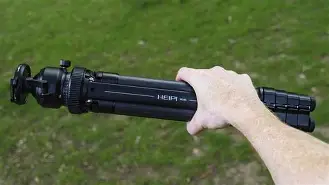
When I first unboxed the Heipi, the first thing I noticed wasn't the weight, but the density. At roughly 3 pounds (1.35kg), it isn't the lightest carbon fiber tripod on the market, but it feels incredibly compact. The standout feature is obviously the "3-in-1" design, which centers around a removable sub-tripod that nests inside the main legs. In my experience, most travel tripods rely on a single center column. These columns are notorious for being the weakest link; they vibrate in the wind and add a point of failure. Heipi’s approach replaces that single column with a secondary, miniature tripod. I was surprised by how much this changed my workflow. Instead of just having a tripod, I felt like I had a modular support system. During my first week of testing, I found myself leaving the main legs in the car and just taking the sub-tripod into a local coffee shop to do some low-angle macro work. It was a level of versatility I hadn't realized I was missing.
The Dual-Pillar Innovation: Stability in Practice
The "hype" surrounding this tripod mostly focuses on the dual-pillar design. Most tripods have a circular center column; the Heipi has a three-pronged nested pillar. When the legs are closed, the whole unit is almost perfectly cylindrical, fitting into the water bottle pocket of my Peak Design backpack with room to spare. But the real test was out in the field. I took the W28S to a windswept lighthouse at dusk to see if the dual-pillar design actually reduced micro-jitters during long exposures. What I found was that because the center pillar is actually three separate carbon fiber tubes, the torsion resistance is significantly higher than my previous travel tripod. I stayed out for two hours, shooting 30-second exposures, and my keeper rate for sharpness was noticeably higher than what I usually expect from a "compact" kit. I noticed that I didn't feel the need to hang my bag from the center hook as often, which is a testament to the inherent geometry of the design.
The Sub-Tripod: More Than a Gimmick?
One of the features I was most worried about was the sub-tripod. I assumed it would feel like a cheap plastic afterthought. I was wrong. The sub-tripod is made of the same high-quality carbon fiber and aluminum as the main legs. It has its own three-position leg angle adjustments and a 1/4"-20 screw. I've used it in two distinct ways over the last few months. First, as a tabletop tripod for vlogging or long-exposure shots where I could literally place the camera on a rock or a wall. Second, it serves as the height extension for the main tripod. One thing that bothered me initially was the locking mechanism between the sub-tripod and the main legs. It’s a circular twist lock at the base of the neck. It takes a bit of getting used to, and in cold weather while wearing gloves, I found it a bit finicky to tighten securely. However, once locked, it is rock solid.
The Ball Head: A Specialized Tool
The ball head on the Heipi W28S is a departure from the standard Arca-Swiss heads I usually use. It is a low-profile, integrated head designed to fit within the three pillars. I was worried it wouldn't handle the weight of my Sony A7R V with a 70-200mm f/2.8 lens. In my testing, the locking force was impressive for its size. The "click" sounds the head makes when you rotate it as a pan head are satisfying and help with precise panoramic stitching. However, there is a trade-off. Because the ball head is so compact, the range of motion is slightly more limited than a traditional "neck" ball head. If you are doing extreme vertical shots or pointing the camera straight up for astrophotography, you might find yourself fighting the cutouts in the head. It’s a specialized tool for a specialized tripod, and while I’ve grown to appreciate the weight savings, there are days when I miss the simplicity of a standard, larger ball head.
Discover deals on Cameras & Photography — updated daily.
Browse Now →Real-World Durability and Handling
After six months of use, the "new gear" smell has long since faded, replaced by the grit of various landscapes. I’ve taken this tripod into salt water and sandy environments. One thing I noticed is that the leg locks—which are lever-style "flip" locks—are remarkably easy to clean. I am usually a "twist-lock" person because they are easier to strip down and regrease, but Heipi’s flip locks have stayed snappy and haven't developed that annoying "crunch" that many budget tripods get after a trip to the beach. I did have one minor disappointment: the rubber feet. While they provide excellent grip on smooth rock, I found that they can be a bit difficult to swap out for spikes. You have to unscrew the rubber, and the threading is a bit shallow. It’s a small detail, but when you’re losing light and trying to stabilize in the mud, every second counts.
Performance Comparison
To give you a better idea of where the Heipi W28S sits in the market, I've put together a comparison based on my personal experience using it alongside a traditional travel tripod and a heavy-duty studio tripod.
| Feature | Heipi W28S (Carbon Fiber) | Standard Carbon Travel Tripod | Heavy-Duty Studio Tripod |
|---|---|---|---|
| Max Height | 150cm (approx. 59") | 140-155cm | 170cm+ |
| Packable Diameter | Extremely slim (no dead space) | Bulky near the top spider | Very Large |
| Low-Angle Capability | Excellent (via sub-tripod) | Requires column reversal | Limited |
| Stability in Wind | High (Dual-pillar design) | Moderate (Center column sway) | Superior |
| Weight | 1.35 kg | 1.1 - 1.4 kg | 2.5 kg+ |
What I Loved: The Pros
- The Compact Form Factor: This is the only tripod I’ve owned that truly fits in a side pocket without making the backpack feel lopsided. The lack of "dead space" between the legs is a design masterstroke.
- Versatility of the 3-in-1: Not having to carry a separate "mini" tripod for low-angle macro work or vlogging from a desk is a huge weight saver in my overall kit.
- Vibration Dampening: The dual-pillar center column is legitimately more stable than a single round tube. I’ve seen the proof in my long exposures.
- The Integrated Phone Mount: I was surprised by how much I used the hidden phone clip inside the center column. It's great for behind-the-scenes shots or using my phone as a remote monitor.
- Build Quality: The carbon fiber weave feels premium, and the machined aluminum parts don't feel like the "pot metal" you find on cheaper alternatives.
What I Disliked: The Cons
- The Tightness of the Nester: Sometimes, sliding the sub-tripod back into the main legs requires perfect alignment. If there is even a little bit of grit or sand in the channels, it can feel like it's sticking.
- Ball Head Limitations: As mentioned, the low-profile head is great for space but can be restrictive for certain extreme angles. I found it frustrating when trying to shoot straight up at the stars.
- Flip Lock Tension: After several months, I had to use the included Allen key to tighten one of the leg locks which had started to slip. It's a quick fix, but something to monitor if you're on a long expedition.
- Price vs. Weight: While it’s not overpriced for what it is, you are paying for the design and compactness rather than just raw weight savings. There are lighter tripods, though they aren't nearly as stable.
Buying Guide: Is the Heipi W28S Right for You?
Buying a tripod is usually a series of compromises. Before you decide to jump on the Heipi bandwagon, you should evaluate what kind of photographer you actually are. After using this for half a year, I believe it caters to a very specific demographic. If you are a travel or landscape photographer who prioritizes packing space above all else, this is likely the best option currently on the market. The way it nests together into a solid cylinder is a game-changer for those who travel by air or hike long distances.
However, if you are a studio photographer or someone who rarely leaves the pavement, you might find the "3-in-1" features to be unnecessary complexity. You could get a simpler, taller tripod for less money if you don't care about the ultra-slim diameter. Furthermore, if you frequently use very heavy wildlife lenses (like a 600mm f/4), the W28S will struggle. While it's great for standard zooms and medium primes, it is still a travel tripod at heart. I found that my 200-600mm lens was pushing the limits of the ball head's locking capacity, especially when tilted at an angle.
Another factor to consider is the operating environment. Because of the nested design, this tripod requires slightly more maintenance than a traditional set of legs. If you are constantly in the mud or sand, you will need to be diligent about wiping down the pillars before nesting them back together. If you’re the type of person who throws your gear in the trunk and forgets about it, you might find the tolerances of the Heipi to be a bit unforgiving over time.
Looking for the best Cameras & Photography deals on Amazon?
Browse Now →Practical Tips from My Experience
If you do decide to pick up the W28S, I have a few tips that I wish I had known on day one. First, always ensure the sub-tripod locking ring is tightened before you mount your camera. I made the mistake once of thinking it was seated correctly when it wasn't, resulting in a heart-stopping moment where the camera wobbled as I let go. Second, utilize the "click" intervals on the ball head for panoramas. I found that three "clicks" usually gave me the perfect overlap for a 35mm lens. Lastly, don't be afraid to use the sub-tripod on its own. It is surprisingly sturdy and has become my go-to "vlog" handle when I need to record a quick update for my followers while walking.
Conclusion
So, is the hype justified? In my honest opinion, yes—with a few caveats. The Heipi 3 In 1 Travel Tripod W28S isn't perfect, but it is one of the most innovative pieces of camera support gear I’ve used in years. It solves the "dead space" problem that has plagued travel tripods since their inception. The stability provided by the dual-pillar design is a tangible benefit that I can see in my own files. While the ball head has some angular limitations and the nesting mechanism requires a bit of care, the overall package is incredibly compelling.
I’ve reached a point where I no longer reach for my smaller, lighter "budget" carbon tripods, nor do I feel the need to lug my heavy-duty legs on anything but the most demanding local shoots. The Heipi has effectively become my "everywhere" tripod. It feels like a tool designed by people who actually carry gear for miles, which is a refreshing change. It isn't just about the three-in-one gimmick; it’s about a tripod that finally stays out of the way until you need it to be rock solid. For the adventurous photographer who is tired of choosing between a heavy back and a blurry photo, this is a compromise I am more than happy to live with.